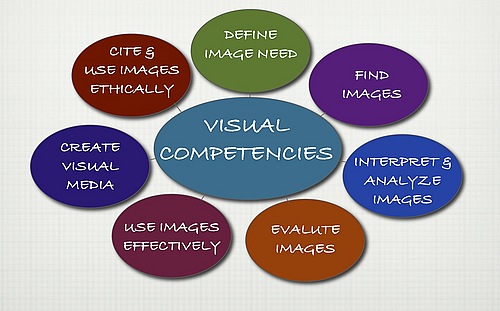
Visual features are important to the craft of almost any text in our current and future world. Visuals are a significant part of the students’ lives today and for their careers in the future. Palmer and Matthews (2015) note that many jobs in science, social science, and health fields require workers to interpret information from various types of images. Therefore, visuals must be a crucial part of instruction and digital writing in today’s classrooms. However, as Hicks (2013) points out, “visual literacy” should allow for educators to teach students how to purposefully choose and/or create visuals that provide a deeper meaning for texts (p. 15).
Since students’ lives are shaped by visuals from television, gaming, phones, tablets, and many other devices, instruction and student-constructed products must utilize visuals to engage students and to make tasks more meaningful. For secondary students, a traditional essay or research project can be much more engaging and meaningful with technology and visuals. In addition to adapting the media for publishing such assignments, images reflecting the topic or theme or a chart or diagram providing more specifics in an organized and visually appealing manner helps the student writer display a deeper understanding of the topic. These visuals also help the student’s audience better understand the topic. The images provide learning connections for the writer and the reader and can enrich learning for all students involved.
 |
| Retrieved from https://apps.carleton.edu/reason_package/reason_4.0/www/images/912243.jpg. |
As an English teacher, I am unfortunately aware of my own deficiencies and those of others in relation to teaching students the appropriate and effective strategies for including visuals with written texts. As Hicks (2013) defines the elements associated with the “craft of writing,” educators must instruct and model for students how to choose or construct visuals and how to appropriately cite sources for images produced by others (p. 16). Just as teachers teach the concepts of diction and tone and how they enhance the writer’s overall purpose, teachers must also teach how visual components, such as background, size, shape, color, and tone, also enhance a writer’s overall purpose within a text.
Additionally, teachers must teach students how to correctly cite sources for images in a similar way to citing sources for written text. The following link includes source documentation for visuals in MLA format, the commonly used style in secondary schools:
In the world of education, we must adapt writing instruction to meet the technological and visual needs of our students and of the world in which they live, play, and will ultimately work.
References
Hicks, T. (2013). Crafting digital writing: Composing texts across media and genres. Portsmouth, NH: Heinemann.
Palmer, M. S., & Matthews, T. (2014). Learning to see the infinite: Measuring visual literacy skills in a 1st-year seminar course. Journal of the Scholarship of Teaching and Learning, 15(1), 1.
Palmer, M. S., & Matthews, T. (2014). Learning to see the infinite: Measuring visual literacy skills in a 1st-year seminar course. Journal of the Scholarship of Teaching and Learning, 15(1), 1.